
Research behind the recipe
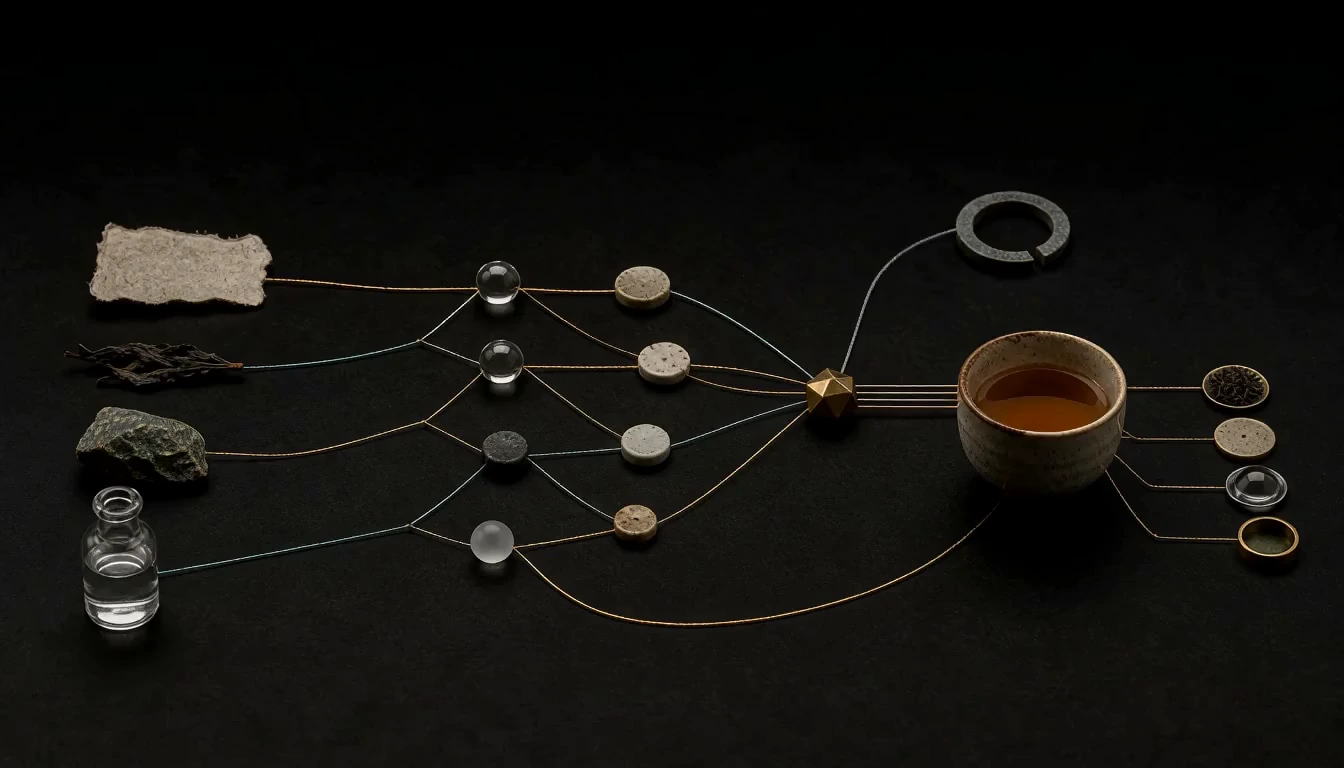
A knowledge graph connects sources, findings, and calculations. Open a recipe detail below to see what supports it—and what still needs testing.
From sources to a brewing suggestion
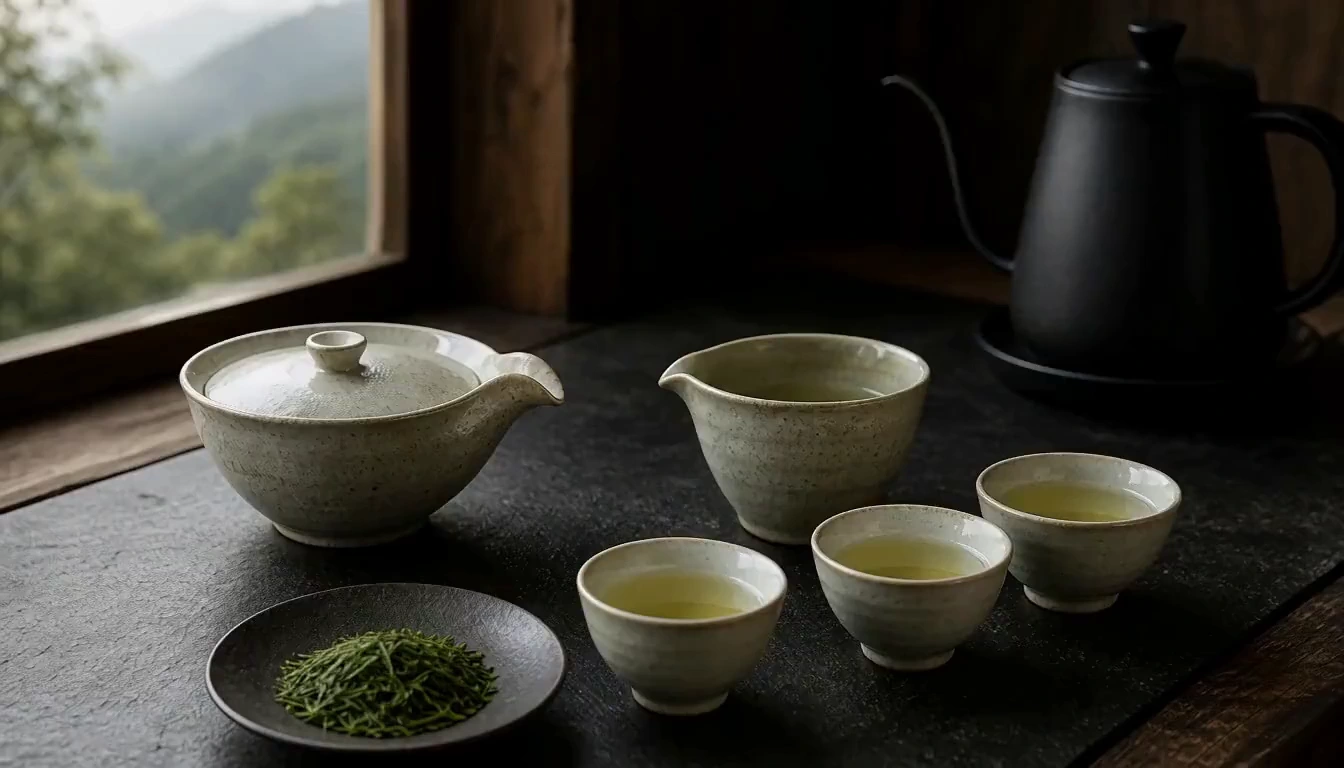
Gensen Tezumi Shincha
Kirishima · Saemidori
- Status
- Current best trial
- Evidence
- 21 verified sources
- Lineage
- 4 revisions
- Confidence
- Moderate
Dose
1 linked claimAdjusting the seller’s dose for this pot
Why this choice?Calculated value
3.5 g/100 ml seller-range midpoint scaled to 120 ml: 3.5 × 1.2 = 4.2 g.
The new 60°C, 75-second brew has not been tasted yet. It could still be bitter or too weak.
The seller specifies approximately 3-4 g per 100 ml, 60-65°C water, and 1.5-2 minutes for Gensen Tezumi Shincha.
Extraction
3 linked claimsTrying a shorter brew after a bitter cup
Why this choice?Choice to test
The previous 105-second brew tasted quite bitter, so the next trial is shorter than the seller recommends. This timing has not been shown to taste best.
The new 60°C, 75-second brew has not been tasted yet. It could still be bitter or too weak.
The seller specifies approximately 3-4 g per 100 ml, 60-65°C water, and 1.5-2 minutes for Gensen Tezumi Shincha.
The prior 65 °C / 105 s first infusion tasted quite bitter.
The next trial deliberately reduces extraction after the bitter outcome.
Vessel
4 linked claimsA small pot with a fast-draining filter
Why this choice?Choice to test
This pot was chosen for its known capacity, glaze, and fast filter. It has not been shown to make better-tasting tea than the other pots.
We do not yet know how the tea’s taste differs between the glazed hōhin, Hōryū, and Hokuryū pots.
Tezumi lists the houhin capacity as 150 ml.
A direct fill measurement confirmed the hōhin's working capacity.
Tezumi describes the Asahiyaki houhin as transparent-glazed hanshi clay.
The houhin has a 150-hole do-ake direct filter designed for quick leaf straining.
Water
3 linked claimsKeeping the water consistent
Why this choice?Choice to test
Lauretana is the water chosen for this home trial. Its recorded mineral content broadly fits the seller’s soft-water advice, but the current bottle label has not been checked independently.
This recipe assumes Lauretana water. The mineral figures came from the user; the current bottle label has not been checked independently.
The seller recommends soft water, filtered if necessary, for full enjoyment of its rare green teas.
Lauretana is the explicit water constraint for this home trial.
The represented water options differ materially in mineral content; current labels remain unverified.
Wuliang Palace Shou
Yunnan · ripe pu-erh
- Status
- Current best trial
- Evidence
- 13 verified sources
- Lineage
- 3 revisions
- Confidence
- Moderate
Vessel
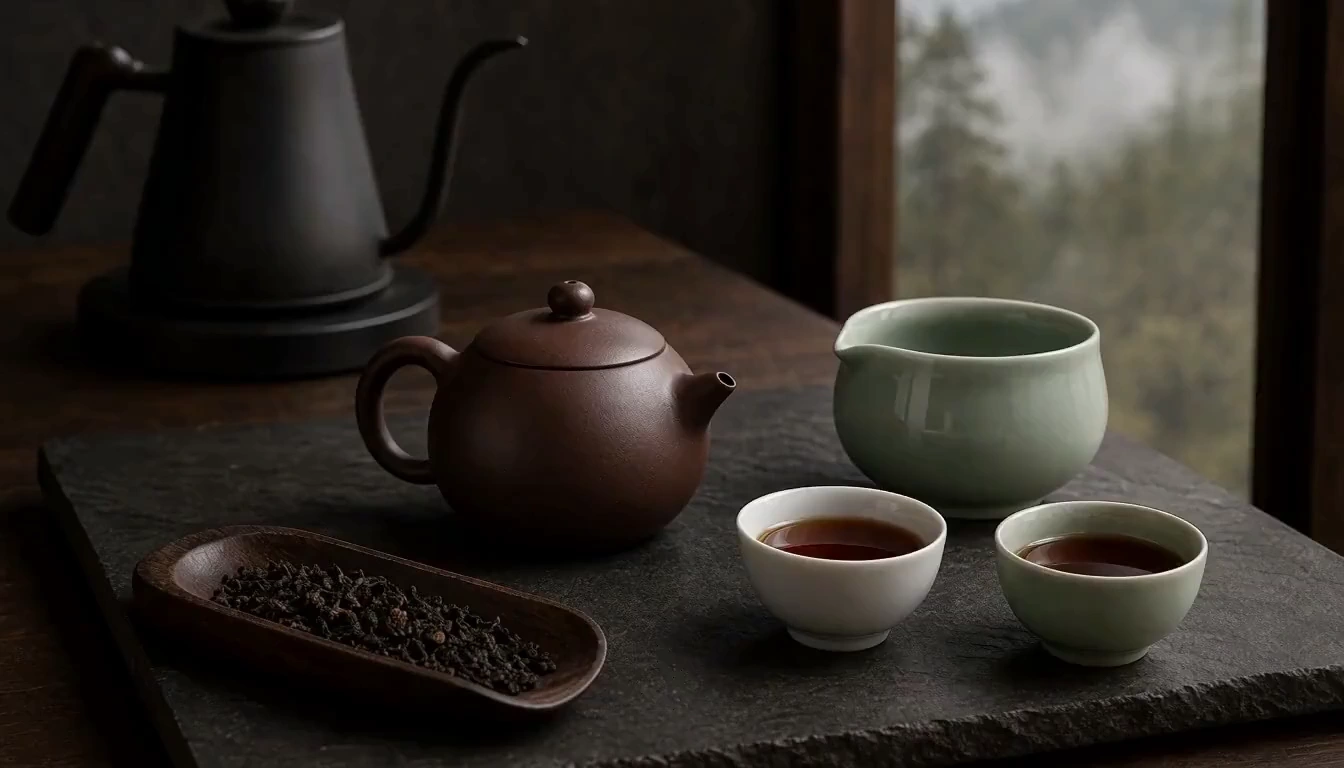
2 linked claimsA pot used only for this tea
Why this choice?From the source
I already have this Xi Shi pot and have used it only for this tea. That makes it a consistent choice, but does not prove it tastes better than porcelain.
The 145 ml working fill comes from an older note and needs remeasuring. A side-by-side tasting is still needed to compare this pot with others.
The Xi Shi pot has been used only for this Wuliang tea.
A 200 ml Xi Shi zi-ni pot is represented as available.
Heat
3 linked claimsBoiling water, adjusted to the pot’s fill
Why this choice?Calculated value
This starts from general gongfu brewing guidance. The temperature when water reaches the leaves has not been measured.
100°C is the kettle’s display reading, not a measured temperature at the leaves.
The seller specifies two well-heaped teaspoons in 150 ml at 100°C and a 30-second first infusion.
A specialist pu-erh guide recommends 6 g per 100 ml and boiling water as a weight-based gongfu baseline.
Fellow specifies a 40–100°C range for the Stagg EKG Pro and says it maintains the selected target temperature.
Rinse
1 linked claimFollowing a ripe pu-erh rinsing guide
Why this choice?Calculated value
Three seconds is the upper end of the guide’s two-to-three-second range, chosen to make the rinse easy to repeat.
This advice is for ripe pu-erh generally. Its benefit for this particular tea has not been tested.
A specialist ripe-pu-erh guide recommends two rinses and states a two-to-three-second rinse duration.
Timing
2 linked claimsAn infusion schedule still to test
Why this choice?Choice to test
The schedule lengthens successive infusions, following the seller’s general advice. The exact times are a proposal to taste and test.
The first brew at 6.0 g/145 ml, a 100°C kettle setting, and 8 seconds has not been tasted yet.
These exact brew times came from an earlier AI-generated recipe. They have not been established as the best timings.
This recipe combines the available guidance into a trial. It has not been shown to taste best.
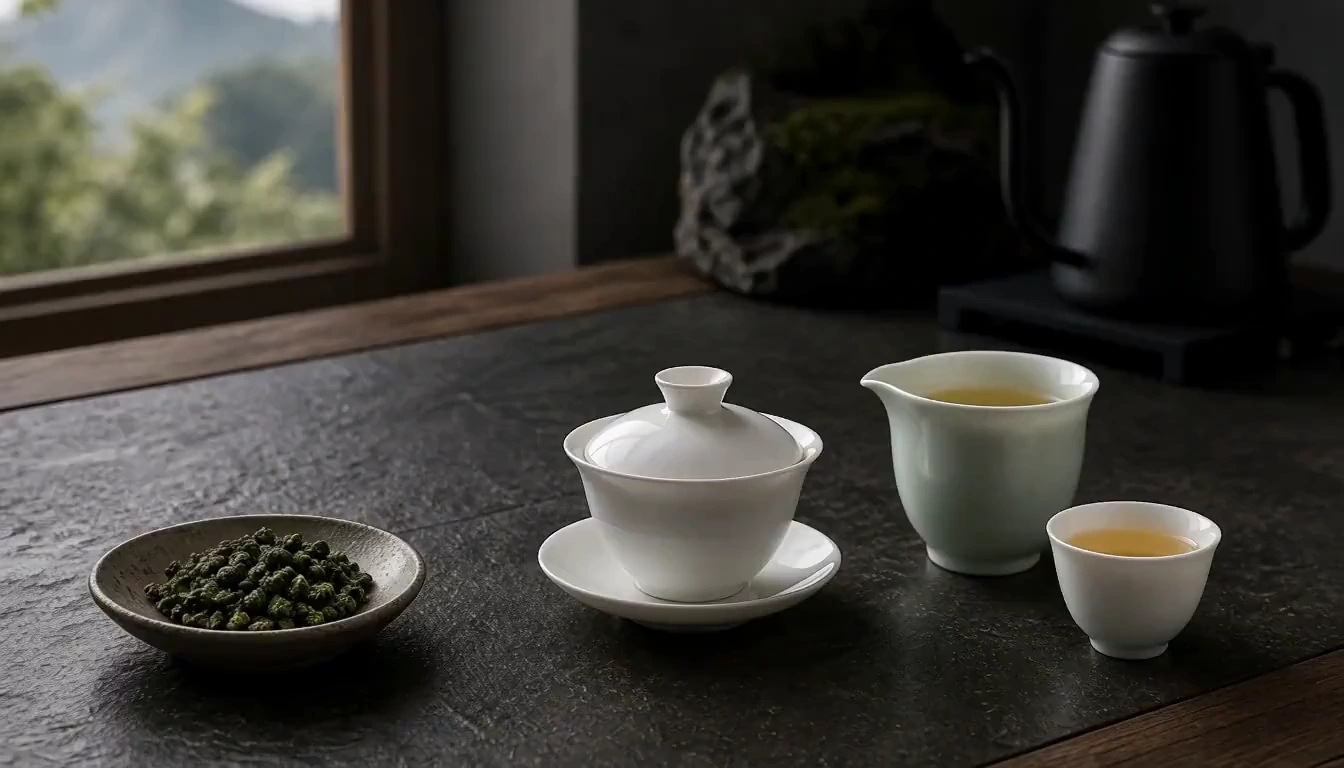
Qing Xiang Tie Guan Yin
Anxi · light-roast oolong
- Status
- Current best trial
- Evidence
- 14 verified sources
- Lineage
- 3 revisions
- Confidence
- Moderate
Outcome
3 linked claimsReturning to a dose I enjoyed
Why this choice?From the source
After the 7 g brew disappointed, this returns to a dose I previously enjoyed rather than trying an even denser, untested recipe.
The first three brews at 5.0 g/60 ml, 98°C, and 5/7/9 seconds, using this water blend, have not been tasted under the new timing method.
A 7 g / 90 ml / 20 s first infusion was borderline bitter and lacked the expected floral and umami character.
The lighter prior protocol had produced enjoyable results.
After the bitter result, this trial returns to the previously enjoyed recipe. Its remaining uncertainties still apply.
Extraction
2 linked claimsShorter brews, not a proven ideal timing
Why this choice?Choice to test
A 20-second brew was bitter, so this returns to shorter infusions I had enjoyed before. The cited studies do not establish these exact timings.
Later brew times, whether rinsing improves taste, and whether cooler water helps a bitter, flat cup still need testing.
In the cited long-infusion Tieguanyin experiment, a higher water-to-tea ratio or lower temperature produced less bitterness-astringency; the tested range did not include five-second gongfu infusions.
After the bitter result, this trial returns to the previously enjoyed recipe. Its remaining uncertainties still apply.
Leaf opening
1 linked claimTaste the first three infusions together
Why this choice?Choice to test
In the study, dry leaves first had to absorb water, limiting extraction in the first brew. Taste the first three together rather than expecting the first cup to show all the floral and umami notes.
The first three brews at 5.0 g/60 ml, 98°C, and 5/7/9 seconds, using this water blend, have not been tasted under the new timing method.
In the cited three-infusion Tieguanyin experiment, first-infusion extraction was harder because dry leaves first absorbed water, so the first cup alone may underrepresent later release.
Water
3 linked claimsReusing a water blend I enjoyed
Why this choice?Choice to test
This reuses a water blend I previously enjoyed. Its exact mineral content has not been verified, and it may not match the waters in the study.
Neither bottle’s current label or exact mineral content has been checked. We do not know whether the blend matches the moderately mineralized waters in the study.
In a six-minute Tieguanyin brewing study, the moderately mineralized natural and spring waters tested gave better aroma results than the pure and highly mineralized waters tested. This does not establish the right composition for this recipe’s blend.
The prior protocol records the 5 g dose, 60 ml working fill, water blend, rinse, and short infusion ladder.
After the bitter result, this trial returns to the previously enjoyed recipe. Its remaining uncertainties still apply.
AI comparison
Does the research help AI?
11 models · 2 tea questions · scores out of 100
- 01GPT-5.5 · xhighAI alone83.9With graph79.2-4.6changeΣ 163.1
- 02GLM-5.2 · reason 16kAI alone82.3With graph80.8-1.4changeΣ 163.1
- 03Kimi K2.6 · autoAI alone75.8With graph79.6+3.8changeΣ 155.4
- 04Gemini 3.1 Pro · dynamicAI alone78.6With graph75.0-3.6changeΣ 153.6
- 05Ornith 1.0 35B · nativeAI alone77.4With graph72.4-5.0changeΣ 149.8
- 06Qwen 3.6 35B-A3B · highAI alone59.5With graph83.1+23.6changeΣ 142.5
- 07Qwen 3.6 35B-A3B BF16 · highAI alone68.3With graph62.1-6.3changeΣ 130.4
- 08Gemma 4 31B BF16AI alone56.9With graph67.9+11.1changeΣ 124.8
- 09GPT-OSS 120B · highAI alone66.3With graph50.6-15.7changeΣ 116.9
- 10MiMo V2.5 · reason 16kAI alone53.8With graph61.1+7.3changeΣ 114.9
- 11Phi-4AI alone37.5With graph38.5+1.0changeΣ 76.0
Other tests